
Is the Pantheon Free? Who Gets In Without a Ticket
Short answer: yes, the Pantheon is free for several groups — under-18s, residents of Rome,
licensed tour guides, and worshippers attending Mass all enter without a ticket. Everyone else pays, either
the €7 full price or the €2 reduced rate. There is also one day each
month when the Pantheon is free for absolutely anyone, walk-in only. This page sets out exactly who qualifies,
what the rules are on each free route, and when the free option is actually a worse deal than paying.
🧨 The honest bottom line
Six groups get in free on ordinary days, one group pays €2, and everyone else pays €7. Beyond
that, entry is free for absolutely anyone on the first Sunday of every month and on the national free days
the Ministry of Culture announces one at a time. The free-first-Sunday route is real, but it is a queue,
not a shortcut — and the Ministry says the free ticket carries no priority access. If that is not
your idea of a morning, the €7 timed ticket is usually the better buy.
Who Gets In Free at the Pantheon
The Pantheon is run by the Ministry of Culture and the Diocese of Rome under an agreement signed on
10 April 2026. The gratuities (free and reduced entry) below are unchanged by the
€5 → €7 increase that took effect on 1 July 2026.
- Under-18s — free entry regardless of nationality. A free ticket is still issued,
and proof of age may be requested. - Residents of Rome — free with valid proof of residence ID.
- Licensed tour guides — free with current professional registration.
- Visitors with a disability, plus one companion — both free; the companion must
show that they belong to a social or health-care assistance service. - EU school groups — students and teachers of EU public and private schools are free;
the school collects the tickets on site against a signed list of participants. - Worshippers attending Mass — free for those taking part in the service.
- First Sunday of each month — free for everyone, part of the national
Domenica al Museo (“Museums on Sunday”) initiative. - National free days — free for everyone on the days the Ministry of Culture
designates and announces one at a time (in 2026: 25 April and 2 June). No future date is published in
advance.
First Sunday of the month — the one free day for everyone
On the first Sunday of every month the Pantheon is free for everyone, no eligibility check, as
part of the national Domenica al Museo initiative. This is the route most visitors mean when they ask
“is the Pantheon free?”.
- Walk-in only. There is no online booking for free Sunday entry and no reserved slot. You
turn up and join the queue. - Paper ticket. You collect a paper ticket on site at the entrance.
- Queue. Everyone joins a single line to collect the free ticket, and the Ministry says
that on free days the ticket carries no priority access.
💳 The honest ROI advice
If the free-Sunday queue is already 2 hours when you arrive, it is usually worth paying the
€7 and booking a timed slot for a quieter visit on another day. The building is the
same either way — the difference is your afternoon. Two hours of your holiday time is worth more than
€7. For the rest of the day, kosher, halal, vegetarian and gluten-free places to eat near the Pantheon are listed with their walk from the portico.
The €2 reduced ticket
EU citizens aged 18–25 pay a reduced rate of €2 with valid photo
ID. Non-EU students do not qualify for this rate. The ticket is nominal: the name on the
booking must match the ID you bring, and it is checked at entry.
Everyone else pays €7
If you do not fit any of the free categories and are not an EU citizen aged 18–25, the full price is
€7. That price rose from €5 on 1 July 2026 and is the tariff in
force today; the Ministry has published no end date for it and no 2027 tariff at all, so there is no 2027
figure to quote. Buying on the day or booking in advance costs the same — the difference is only whether
you are guaranteed a slot.
Why the Pantheon Is More Than a Ticket
Part of what makes the free-entry question worth asking is that the Pantheon is not just a paid attraction.
It is an active Catholic basilica, officially the Basilica di Santa Maria ad Martyres
(“St. Mary of the Martyrs”). It has been a working church since 609 AD and is still used for
worship today. That is why worshippers attend Mass free and why the building carries a dress code.
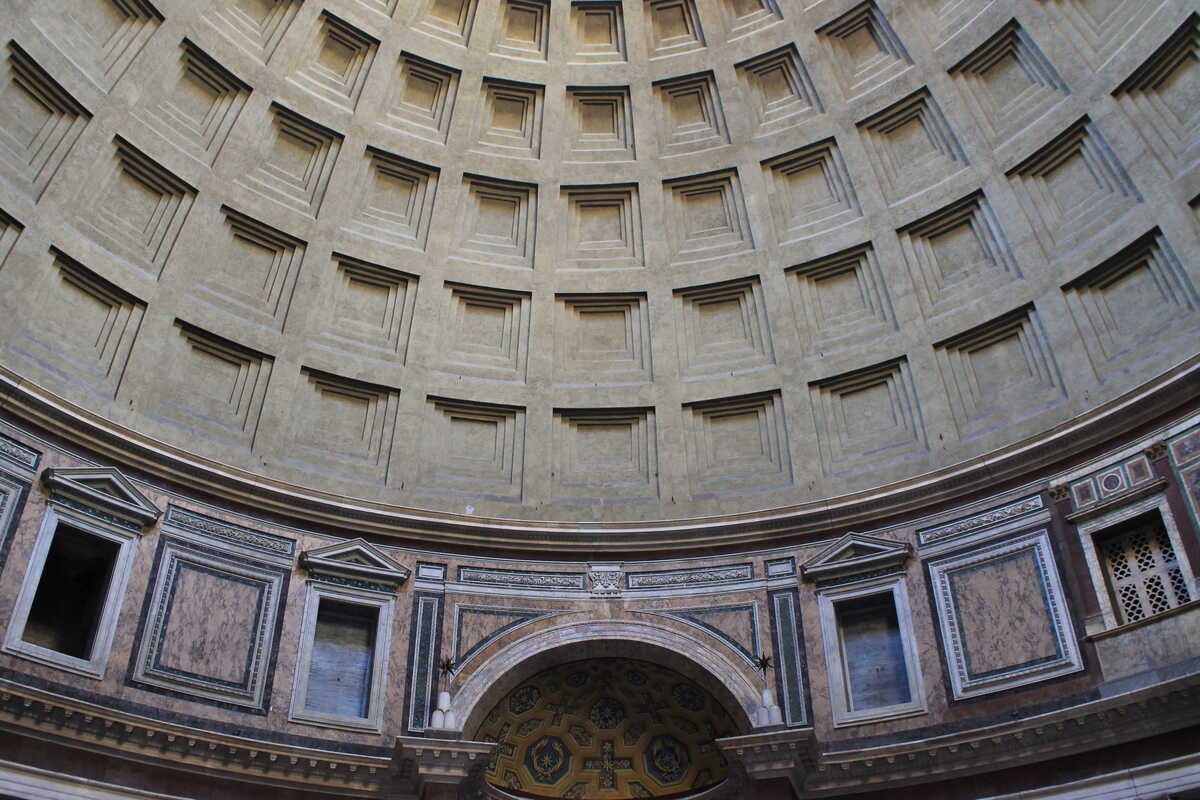
The active-basilica angle
- Santa Maria ad Martyres — the Pantheon’s official church name. The basilica
operates under the authority of the Diocese of Rome. - Mass schedule — Saturday at 17:00 and Sunday at
10:30. Tourist access is suspended during Mass, when the basilica is
reserved to worshippers; ticket sales stop an hour before each service begins. - Dress modestly — shoulders and knees covered, as in any Catholic church. No large
backpacks or tripods. - Raphael’s tomb — the Renaissance painter is buried inside the basilica, in
the third chapel on the left. - The oculus — the 9-metre open circle in the centre of the dome lets daylight rain
directly onto the floor. It is the building’s most famous feature and free to look at from any seat.
If you are visiting as a visitor rather than a worshipper, entry is still free, but you are expected to remain
quiet and seated during the service. The Mass route is the quietest way to experience the building.
Should You Go Free or Pay?
Three quick checks, in order:
- Do you qualify as under-18, a Rome resident, a licensed guide, a visitor with a disability, part
of an EU school group, or are you attending Mass?
— Then entry is free on any ordinary day; you still join the same line and collect a ticket. - Are you an EU citizen aged 18–25? — Then the €2 reduced ticket is the
obvious choice. Book a timed slot and walk in. - Is it the first Sunday of the month and you do not mind a queue? — Then go free, but
set expectations: paper ticket, walk-in only, one line for everyone and no priority access. If the line is
already long when you arrive, pay the €7 for another day.
For everyone else, the answer is simple: book the €7 timed ticket. It is the same price
whether you book in advance or buy on the day, but the slot guarantees you entry on a busy day and costs you
roughly one hour of your holiday instead of two.
How to Book the Paid Ticket
Timed entry is mandatory on paid days. You cannot simply turn up and pay at the door. Slots
for the following month open in the middle of the current month, so book as soon as your travel dates are
fixed.
Official channel — museiitaliani.it
The official Ministry of Culture booking portal is museiitaliani.it. It sells the €7 ticket with no audio guide and no guided tour
add-on. Tickets are nominal: the name on the booking must match the ID you bring, and it is
checked at entry.
Third-party resellers
GetYourGuide, Tiqets, and Viator hold their own allocations and release slots further out than the
official portal. They typically add a service fee on top of the €7 entry price, and some bundles include
an audio guide or a hosted entry.
pantheonroma.com is the main bundle option pairing entry with an audio guide.
🚨 No skip-the-line exists
There is no skip-the-line channel for the Pantheon. Every visitor enters through the same
flow. Third-party resellers sell easier booking, hosted or app-led entry, and guided tours — none of
them buys you a faster queue.
Opening Hours, Mass & Closures
The Pantheon operates on a single timetable with no separate seasonal hours. It is open
09:00–19:00 daily, year-round, with last entry at 18:30 and ticket
sales stopping around 18:00.
Mass interruptions
The Pantheon is an active Catholic basilica (Santa Maria ad Martyres). Tourist access is suspended
during Mass: Saturday at 17:00 and Sunday at 10:30, and ticket
sales stop an hour before each service. If you want to see the building without an interruption, avoid the
hour either side of those two services.
Closures
The Pantheon is closed on only two days: 25 December and 1 January. It is
open every other day of the year. Some secondary sources list reduced hours on 1 May and 15 August
(Ferragosto); the official position is a year-round 09:00–19:00 timetable, but allow a little
flexibility on those two public holidays if you are travelling then.
Best Times to Visit
- Early morning, 09:00–10:00 on a weekday — the quietest slot. Arrive at
opening for the shortest queue. - Late afternoon, 16:00–18:30 — softer light through the oculus and fewer
families with children. - Avoid Sunday mornings if you want to skip the 10:30 Mass interruption and the free-Sunday
crowds.
FAQ — Is the Pantheon Free?
- Is the Pantheon free? — Yes, for under-18s, Rome residents with ID, licensed tour
guides, visitors with a disability and one companion, EU school groups, and worshippers attending Mass.
It is also free for everyone on the first Sunday of each month (Domenica al Museo) and on the national
free days the Ministry of Culture announces one at a time. - Can anyone just turn up on the first Sunday and get in free? — Yes. Entry is
walk-in only with no online booking. You collect a paper ticket on site, from the same single line as
everyone else, and on free days the ticket carries no priority access. - How much does it cost if I do not qualify for free entry? — €7 full price, or
€2 reduced for EU citizens aged 18–25 with photo ID. - Is the first-Sunday free scheme year-round? — The 2026 official sources describe it
as the first Sunday of every month. Some secondary sources suggest it historically ran October to March
only; this should be confirmed against
direzionemuseiroma.cultura.gov.it before relying on a specific date. - Do I need ID for free entry? — Yes for reduced and resident categories. Nominal
tickets are checked against your name at entry. - Can I skip the line if I book through GetYourGuide or Tiqets? — No. There is no
skip-the-line channel: the Ministry says the visit takes place in order of arrival, and a booked slot buys
you a time, not a place at the front. - Is the Pantheon still a church? — Yes. It is the Basilica of Santa Maria ad
Martyres, an active Catholic basilica with Mass on Saturday at 17:00 and Sunday at 10:30.
Related Planning
For a full plan, pair this page with the rest of the Pantheon Rome guide:
- Tickets — the full rate table, booking channels, and the
nominal-ticket-ID rule. - Opening Hours 2027 — the full daily schedule, Mass interruptions,
and the best times of day. - Hotels near the Pantheon — lodging around Piazza della
Rotonda, Piazza Navona, and Campo de’ Fiori. - Pantheon vs Colosseum — a side-by-side comparison for
deciding between the two.