
Pantheon vs Colosseum: Which to Visit First, and What Each One Costs
Visit the Colosseum first. From 25 October to 28 February its last admission is
15:30 while the Pantheon takes visitors until 18:30 every day, so the
Colosseum is the leg that can run out of day. On money and time the two are not close: the Pantheon is
€7 and 30–45 minutes, the Colosseum is €24 and most of a
morning. The Pantheon is the easy win; the Colosseum is the one that needs a booked slot and a start time
you keep.
💶 Both in one day, by the numbers
- Tickets: €7 Pantheon + €24 Colosseum Full Experience = €31
per adult, before any reseller fee. - Time: roughly four to five hours of visiting, plus a 2 km walk between them.
- The constraint: your Colosseum slot. Everything else in the day fits around it.
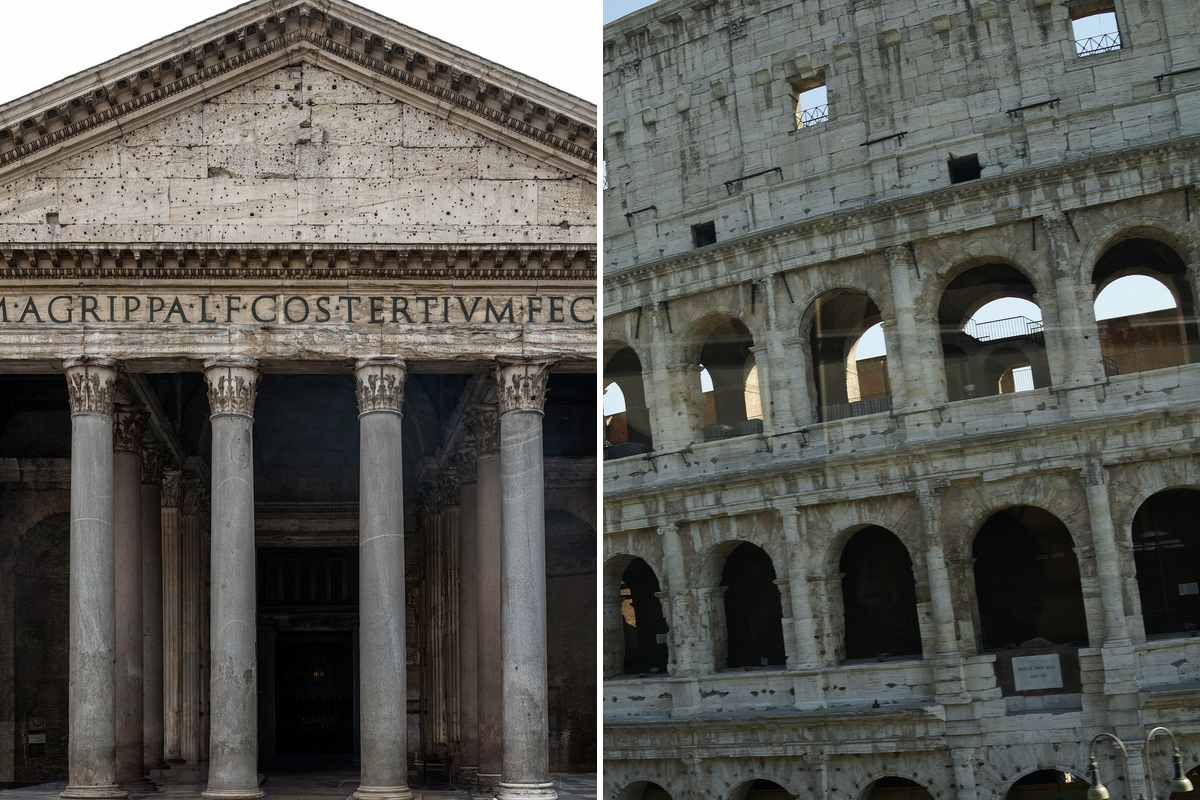
Colosseum’s outer arcades — about 2 km and €17 apart.
Pantheon vs Colosseum at a Glance
| Pantheon | Colosseum | |
|---|---|---|
| Entry fee | €7 full, €2 reduced; free under-18 and on the first Sunday of the month | €24 Full Experience (Colosseum, Roman Forum, Palatine, arena floor); €2 for EU 18–25; free under 18 |
| Window to book | Timed entry through the Musei Italiani portal or app, or on site at the ticket office and totems | Sold 30 days ahead on ticketing.colosseo.it |
| Opening hours | 09:00–19:00 daily, last entry 18:30 | 08:30–16:30 (25 Oct–28 Feb), last entry 15:30; later in summer |
| Time inside | 30–45 minutes | 75 minutes in the amphitheatre (90 with a Full Experience ticket); 2–4 hours with the Forum and Palatine |
| Skip the line | No skip-the-line route exists; a timed slot is what saves you the wait | Timed entry is compulsory, and Full Experience slots sell out quickly |
| Crowds | Moderate; busiest 11:00–14:00 and 15:00–17:00 | Severe; be there before 09:00 or take the last slot of the day |
| Roma Pass | Not included | Included, but a slot still has to be booked |
| Best for | A quick, near-free architectural visit with a working church attached | Anyone who wants the gladiator story and a half-day archaeological site |
What Each One Costs
The Pantheon: €7
A full Pantheon ticket is €7, the reduced rate is €2, and
under-18s go free. Entry is timed and sold through the official Musei Italiani channels or at the door, so the
ticket is a slot as much as a price. The Pantheon ticket guide covers the
booking channels and the nominal-ticket rule.
The Colosseum: €24
The Colosseum’s €24 Full Experience covers four things: the amphitheatre, the Roman
Forum, the Palatine and the arena floor. EU citizens aged 18–25 pay €2, and
under-18s go free. Timed entry is compulsory, and tickets are released 30 days ahead on ticketing.colosseo.it. Two adults pay €14 at the Pantheon and €48 at the
Colosseum.
The first Sunday of the month: free at both, and the worst day to do both
Both monuments drop their entry fee on the first Sunday of the month. At the Colosseum that day is not the
same visit: the arena and the underground areas are closed, as are the panoramic lift and the upper levels,
and free tickets are handed out in order of arrival at the ticket office in Piazza del Colosseo. At the
Pantheon it is walk-in only, paper ticket, queue. You save €31 and lose the best of the Colosseum,
having queued at both. If your Rome day falls on the first Sunday, pay, or move the visit.
How Much of the Day Each One Takes
The asymmetry is the whole decision. The Pantheon is 30–45 minutes inside; there is
no surrounding site to walk and no second building to queue for.
The Colosseum is 75 minutes inside the amphitheatre — the permanence period the
park’s visitors regulation sets for the standard ticket. The same
ticket gives you one entry to the Roman Forum and Palatine at any time within 24 hours before or after your
Colosseum slot. Count 2–4 hours for the Colosseum with the Forum and Palatine, and
3–5 hours if you take the Full Experience including the arena floor.
So the Pantheon is a coffee stop and the Colosseum is a half-day. Treating them as two versions of the same
outing is how people end up sprinting the Forum.
Crowds and the Best Time to Arrive
The Pantheon is moderately busy: the peaks are 11:00–14:00 and
15:00–17:00, so the quiet windows are opening time and the last hour before the 18:30
cut-off. It is a working church: Mass is on Saturday at 17:00 and Sunday at 10:30, and ticket sales stop an
hour before a service. A Sunday morning visit is therefore the least reliable slot in the week.
The Colosseum is the crowded one. Arrive before 09:00 or book the last slot of the day, and
book the moment your dates are fixed — the 30-day release window is the one that matters.
What You Cannot Miss in Each
Pantheon
- The dome. 43.3 metres across, poured in unreinforced concrete, and the widest dome in
the world for 1,300 years. It is the reason engineers still visit a temple. - The oculus. An open circle about 9 m across at the apex, the building’s only source of daylight
and its only opening to the sky. - The continuity. The structure that stands today is Hadrian’s reconstruction of
118–125 AD, in continuous use for roughly 1,900 years — temple, then church.
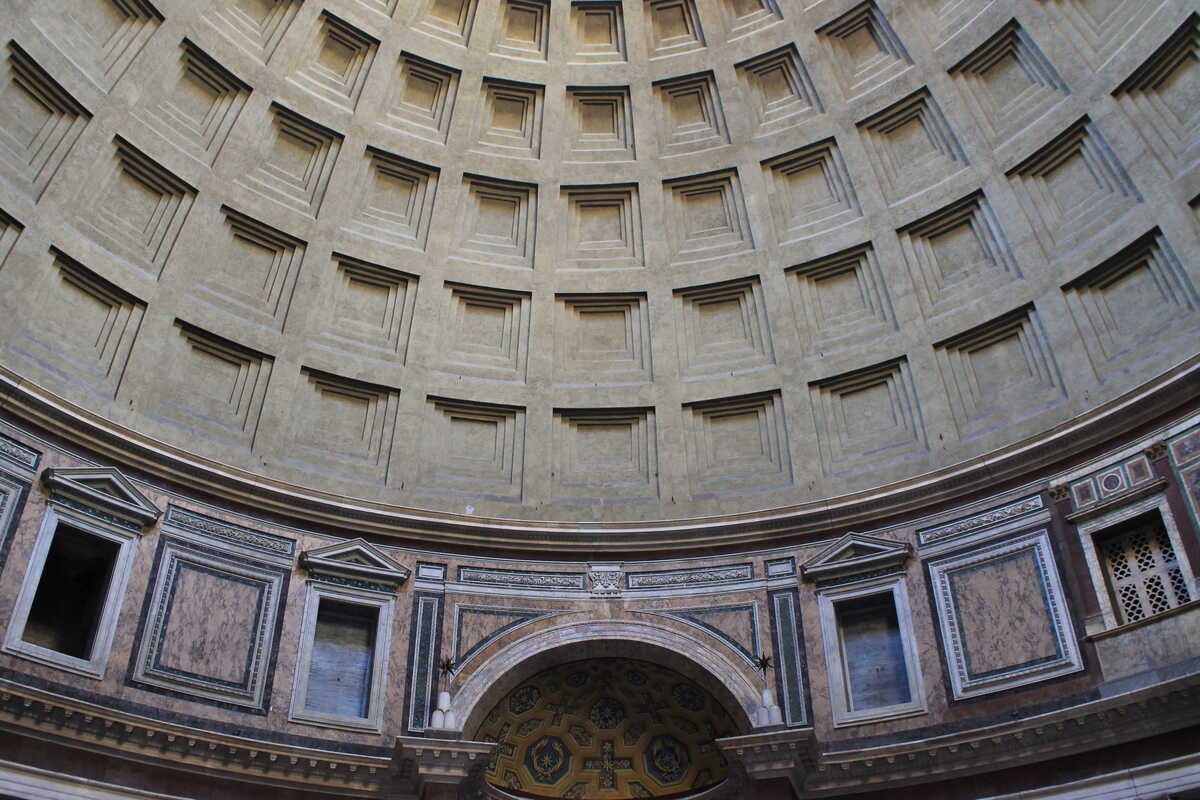
sky.
Colosseum
- The hypogeum. The underground tunnel network beneath the arena floor, the part that
explains how the spectacles were staged. - The structure itself. More than 80 arches, seating for 50,000–80,000 people, built
between 70 and 80 AD under Vespasian and Titus. - The arena floor. Included in the Full Experience, and the reason to pay for it.
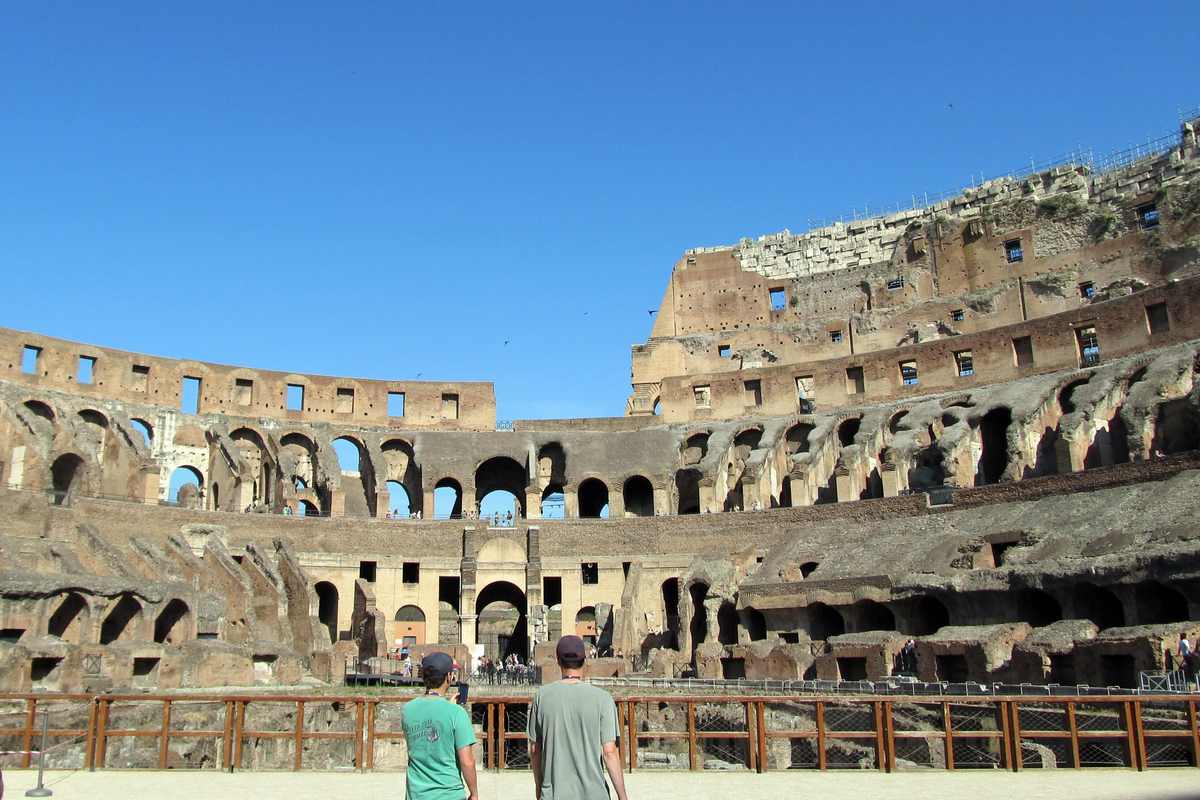
the Full Experience ticket opens.
Photography at Each One
Photography is free at both; the restrictions are practical. The Pantheon allows
photographs, but professional photography and filming need the museum direction’s authorisation, and the interior light is flat — the shot that works is
the shaft of light under the oculus. At the Colosseum, photography on
the arena floor is part of the Full Experience ticket. Neither
building needs a permit for ordinary photographs. A tripod, flash or artificial light needs prior authorisation at the Colosseum, and so does a professional shoot; at the Pantheon the published rules say nothing about tripods at all — a gap, not a permission. Our Pantheon dress code and visitor rules page has the published rules in full, and the questions they leave open.
Which to Visit First
The rule is the timetable, not taste: the Colosseum closes first, so it goes first. How strictly that binds
you depends on how much day you have.
One morning
Colosseum at opening, Pantheon afterwards. Take the earliest slot you can get, then walk down past the
Imperial Fora to the Pantheon with the afternoon intact. The reverse order wastes the morning: the Pantheon
takes 45 minutes and leaves you joining the Colosseum queue exactly when it is at its worst.
One afternoon
Colosseum slot by about 13:00 from 25 October to 28 February, when last admission is
15:30; then the Pantheon, which stays open until 19:00 with last entry at 18:30. In summer, when the
Colosseum runs into the evening, the order matters far less and you can take whichever slot is available.
If the Colosseum is sold out for your dates, the Pantheon still works: its timed entry is not tied to a
30-day release.
A full day
Colosseum and Forum in the morning, lunch in the centro storico, Pantheon and Piazza della Rotonda in the
late afternoon, when the coach groups have gone. The Pantheon absorbs delay; the Colosseum does not. Put the
fixed thing first and the flexible thing second, every time.
Doing Both in One Day
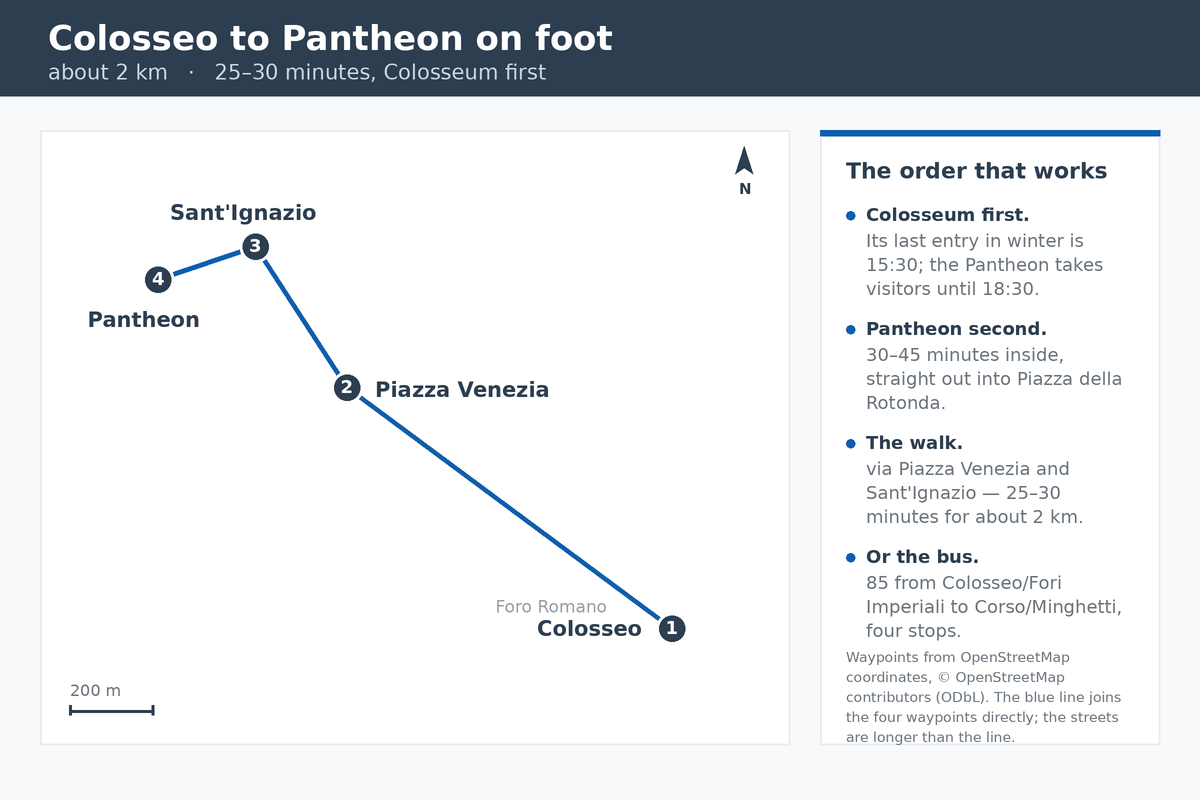
The two are about 2 km apart, a 25–30 minute walk in either direction, along the
Imperial Fora axis past Piazza Venezia and then through Sant’Ignazio to Piazza della Rotonda. Budget the
upper end of that range: it is a city walk, not a park stroll.
Bus 85 is the alternative: Colosseo/Fori Imperiali to Corso/Minghetti
— four stops, about nine minutes on board — then six minutes on foot to Piazza della Rotonda, on
a €1.50 BIT ticket valid for 100 minutes. On Sundays and public holidays Via dei Fori
Imperiali is pedestrianised and the 85 is diverted, though it still reaches Corso/Minghetti. For one trip the
walk usually wins; the ticket earns its keep only if you are riding again later the same day.
| Time | What you are doing |
|---|---|
| 08:15 | At the Colosseum entrance — the park advises 15 minutes before your slot |
| 08:30–09:45 | Colosseum and the arena floor on the Full Experience |
| 09:45–12:00 | Roman Forum and Palatine on the same ticket |
| 12:00–12:30 | Walk to Piazza della Rotonda |
| 12:30–13:15 | Pantheon: dome, oculus, and out into the piazza |
Start late and the day still works if the Colosseum slot is before about 13:00 in winter; it stops working
after 15:30, when there is no slot left to buy.
Related Planning
- what to wear and bring inside the Pantheon — the published dress code, the bag question and the phone rules.
- Pantheon tickets 2027 — the rate table, booking channels and the
nominal-ticket rule. - Pantheon opening hours — the daily schedule, Mass interruptions and
the best times to visit.